

I grew up in a house where art was basically wallpaper, and a lot of it was canvas. Some pieces were raw and casual, some were dressed up in chunky frames, and a few had that sleek, “gallery” look that made even a thrifted landscape feel important. That polished look usually came down to one decision: floater frame or traditional frame.
If you have canvases mixed into a gallery wall, this choice matters more than people think. Frames change the silhouette, the shadows, and even how “finished” a canvas reads from across the room. Let’s break it down in a way that actually helps when you are standing in your living room holding a tape measure and a frame that might not fit.

The quick difference
A floater frame is built so the canvas appears to “float” inside the frame with a visible gap (a shadow line) between the canvas edge and the frame.
A traditional frame for canvas in this context means a canvas cap or lip frame (sometimes described as rabbeted for canvas) where the frame has a front overhang that overlaps the face edge of the canvas. You see the frame sitting on top of the canvas perimeter, similar to how a frame holds a paper print.
- Floater frame look: modern, gallery-like, clean shadow line
- Canvas cap or lip frame look: classic, framed, more contained
What you will notice
Floater frames show the canvas edges
With a floater frame, you are intentionally seeing the canvas sides and that little negative space around it. This is gorgeous when:
- The canvas edge is painted (gallery-wrapped canvases often are)
- You like a modern, airy finish
- You want the art to feel like an object, not a picture behind glass
Gallery wall tip: Floater frames help canvases sit nicely next to matted prints because they create a crisp boundary without adding visual bulk.
Canvas cap frames hide the edges
A lip or cap frame covers the canvas edge, which can be a lifesaver if the sides are messy, stained, stapled, or just not meant to be seen. The overall look reads more classic and can make a canvas feel closer to a framed print.
Gallery wall tip: If your gallery wall is already busy (lots of mixed frames and textures), a simple cap frame can calm a canvas down visually so it does not shout over everything else.

Cost and value
Prices vary a lot by size and material, but here is the honest pattern I see when helping friends frame canvases:
Floater frames are often pricier
- More specialized construction and hardware
- More precision required for sizing and centering
- Often priced higher, especially custom
If you are framing multiple canvases for one wall, floater frames can add up fast.
Cap and lip frames can be more budget-friendly
- More common, with more options at more price points
- Easier to find ready-made solutions
- In many ready-made cases, they are simpler to assemble and hang
My budget move: If you have one hero canvas and several supporting pieces, put the floater frame on the hero and use simpler cap frames (or unframed canvases) on the supporting cast.
For more ways to stretch your wall-art budget, I keep a running list of ideas in DIY & Budget Art.
Sizing and fit
Floater frames need the right size and depth
You are matching the floater frame to the canvas dimensions, but you also need the frame depth to work with your canvas thickness. Many off-the-shelf floater frames are made to fit common canvas thicknesses like 3/4 inch and 1 1/2 inches, but there is a wide range out there. Check the specs before you buy.
Also, floater frames are designed with a consistent gap, so a close-enough size tends to look off. If the gap is uneven, your eye will catch it immediately.
Quick example (the mistake people make): If you have a 16 x 20 stretched canvas, you typically shop for a floater frame labeled for a 16 x 20 canvas (not the outside measurement of the frame). The frame itself will be larger than 16 x 20 because it has to wrap around the canvas and leave that reveal.
Cap and lip frames are more forgiving, but still have rules
With a cap frame, you need a rabbet deep enough to accept the canvas thickness. Some frames are meant for flat art only and simply will not seat a stretched canvas correctly.
My rule of thumb: If the canvas is chunky (like a 1 1/2 inch gallery wrap), confirm the frame is designed for that depth before you buy.
If you are planning a whole gallery wall and want to avoid the bought-the-wrong-size loop, these two posts make measuring and mapping so much easier:
Canvas types matter
This is the part that quietly decides your frame choice before you even get to style.
- Gallery-wrapped canvas: The canvas wraps around the sides, and the staples are usually on the back. This is the best candidate for a floater frame because the edges are meant to be seen.
- Staple-side canvas: Staples land on the sides. A floater frame will still show those edges, so a cap frame is often the cleaner, more forgiving option.
- Canvas panel: Canvas mounted to a rigid board. These can go in more standard frames, but you still want to confirm the rabbet depth and how you will secure it.
Hanging and assembly
How floater frames usually attach
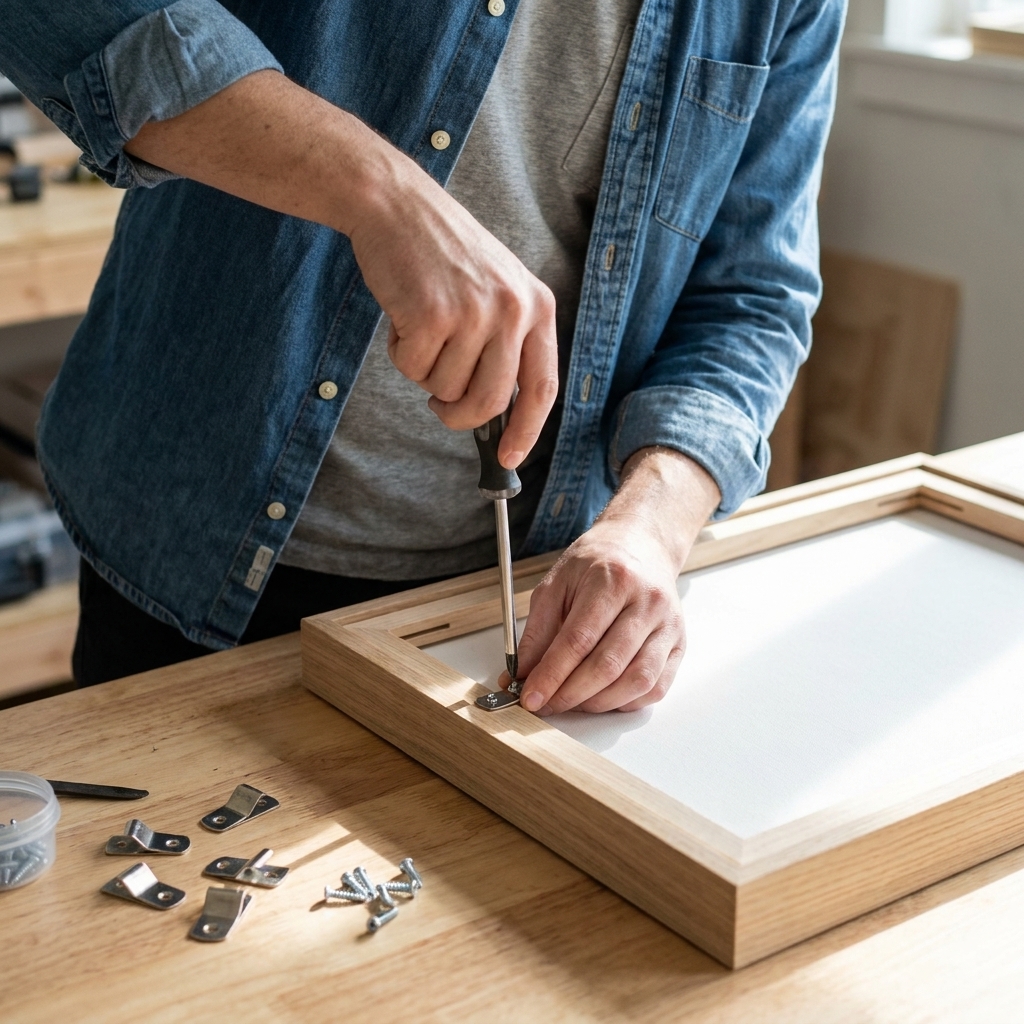
Most floater frames attach to the canvas from the back or sides with small screws and offset clips or brackets. You center the canvas so the reveal (gap) is even all the way around, then secure it.
- Tools you will usually want: screwdriver or drill, measuring tape, a soft surface so you do not scratch the frame
- Time expectation: a little slower, especially the first one
- Common mistake: tightening one side fully before checking the gap all around
My centering trick: Measure the gap on all four sides before you commit. Even a 1/8 inch difference can look crooked once it is on the wall.
How cap and lip frames usually attach
Cap and lip frames for canvas may use offset clips, brackets, or frame points designed to hold the stretcher bars in place. Once the canvas is seated, it behaves more like a typical framed piece, but the hardware depends on the frame build.
- Tools you will usually want: screwdriver, sometimes a small hammer depending on the hardware
- Time expectation: often faster and less fussy, especially with ready-made frames
- Common mistake: using hanging hardware that is not rated for the total weight
If you want a clear rundown of wall hardware options and when to use each, bookmark Picture Hanging Hardware: Hooks, Anchors, and Cleats Explained.
Best for a gallery wall
Choose a floater frame if you want:
- A modern, clean-lined gallery wall
- Your canvas edges visible (and they look good)
- A consistent, elevated finish across multiple canvases
- A shadow line that adds depth without adding bulk
Choose a cap or lip frame if you want:
- A classic framed look that blends with prints and photos
- To hide messy canvas edges
- More budget flexibility and more readily available options
- A calmer silhouette in an eclectic mix
If your wall leans eclectic and asymmetrical, you can absolutely mix both. I actually like using one floater frame as a quiet statement among more character-filled thrifted frames. If that sounds like your vibe, you might like Eclectic Asymmetrical Gallery Wall That Looks Intentional.
My checklist
- Are the canvas edges attractive? If yes, a floater frame is in the running. If no, cap frame.
- Is the piece modern or minimal? Floater frames tend to match the language of the art.
- Is the room traditional, cozy, or vintage-leaning? Cap frames usually blend better.
- Is this a high-traffic area? A cap frame can feel a little more protected at the corners, depending on construction. Some floater frames also protect edges well, so check how the frame sits.
- Am I doing multiples? If yes, consider cost and how much time you want to spend centering and securing floaters.
- Will it sit next to matted prints? Either works, but floater frames often feel more intentional next to clean mats.
Mistakes to avoid
Buying a frame before confirming canvas depth
This is the sneaky one. Two canvases can be the same width and height but totally different thicknesses.
Hanging a heavy framed canvas on the wrong hardware
Canvases get heavy fast once you add a solid frame. Use the right anchors for your wall type and the right hook style for the weight. If you are renting, start with Renter-Friendly Ways to Hang Heavy Frames Without Nails.
Forgetting the frame changes the footprint
If you are planning a gallery wall layout, the frame is part of the final size. Measure the outside edge of the frame, not just the canvas, before you place everything with painter’s tape.
FAQ
Do floater frames protect canvas art better?
They can protect edges from casual bumps, but they are not sealed like glazing on a paper print. Both floater frames and cap frames are mostly about presentation for canvas, not airtight protection.
Can you put a canvas in a normal picture frame?
Sometimes, but only if the frame has a deep enough rabbet to hold the canvas thickness and a way to secure it. Many standard frames are made for flat art and will not fit a stretched canvas properly.
Do floater frames work with thick gallery-wrapped canvases?
Yes, as long as the floater frame depth is designed for that thickness. Always check the depth spec before you buy.
The bottom line
If you want crisp, modern, gallery energy, choose a floater frame and take the time to center it. If you want classic framing, more forgiving edge coverage, and an easy blend with mixed gallery wall pieces, a canvas cap or lip frame is your best friend.
And if you are still torn, here is my simplest advice: Frame the piece you love the most the way you would like it to be remembered. Your wall will take it from there.
For more help getting everything straight and secure, you can browse all my go-to tips in Framing & Installation.