
My laundry room used to be the place I avoided until a hamper started glaring at me from the hallway. Then I realized something that seems obvious in hindsight: I walk into this tiny utility space almost every day, usually when I’m already juggling a basket, a stain stick, and my patience. It deserved a little personality.
The trick isn’t going big. Utility spaces love small scale, vertical movement, and art that can handle real life. Here’s how I plan compact gallery walls for laundry rooms, mudrooms, and those awkward in-between zones so they feel styled, not fussy.

Why utility spaces work
Laundry rooms and mudrooms have a few things going for them that living rooms don’t:
- Short dwell time: You don’t need a huge statement piece to make an impact. A tight cluster of smaller frames reads quickly and still feels intentional.
- Natural zones: Hooks, shelves, cabinets, and machines create built-in boundaries that help you choose a layout size.
- Permission to be playful: A vintage tomato print, an old seed-packet reproduction, or a goofy black-and-white dog photo feels right at home near chores.
Most importantly, these rooms are functional. Your gallery wall should be, too.
Pick your art zone first
Before you choose frames, choose the rectangle of wall you’re willing to commit to. In utility spaces, I like to decide this in a minute by using existing edges.
Three easy zones
- Above a folding surface or counter: Treat it like a mini version of styling art over a sideboard. Keep the bottom row comfortably above anything that gets set down.
- Next to a door frame: A vertical column of frames makes a narrow strip feel finished instead of forgotten.
- Over wall hooks or a bench: If it’s a mudroom moment, art helps it feel like a real entry, not a dumping ground.
If you want a little more structure for planning, I use the same approach as any gallery wall: measure the zone, then build your layout inside it. My favorite low-stress method is the paper-template approach in Paper Templates for a Gallery Wall.

Small layouts that look polished
In utility spaces, compact layouts beat sprawling ones. These are the ones I come back to again and again.
The stacked column
Think 2 to 5 frames in one clean vertical line. Mix sizes, but keep the centers aligned so it reads calm.
- Great next to a door casing, pantry, or cabinet run
- Works with 5x7s, 8x10s, and one slightly larger anchor (like an 11x14)
- Often works in very narrow wall strips, depending on your trim width and frame size
The mini grid
A 2x2 or 2x3 grid is basically a deep breath for your eyes. It’s especially nice if your laundry room already feels visually busy.
- Use identical frame sizes for the easiest spacing
- Keep gaps consistent. I like about 1.5 to 2 inches in small rooms
- Choose one repeating element like all black frames or all oak frames
If grids make you happy, you’ll love the mindset in Symmetrical Grid Gallery Wall, Nailed.
The tiny triptych
Three pieces in a row, same height, evenly spaced. It reads finished without taking over.
- Perfect above a washer and dryer where you have a long, low band of wall
- Try matching frames with different art inside for charm
For more on this idea, see The Rule of Three: Triptych Gallery Walls.

Budget-friendly vintage prints
This is where my flea-market habit gets justified. Laundry rooms and mudrooms are ideal places for thrifted art because the vibe can be relaxed and a little quirky.
What I hunt for
- Botanical and herb prints: Classic, calm, and easy to mix.
- Vintage household ads: Iron, soap, sewing, cleaning-product ephemera. It’s cheeky in the best way.
- Fruit and vegetable illustrations: Especially fun if your laundry room shares a wall with the kitchen.
- Black-and-white family photos: Utility rooms are surprisingly great for personal history because it feels intimate.
- Postcards and maps: Easy to frame in small sizes and usually inexpensive.
If you need help stretching a tiny art budget, I put a bunch of my go-to tricks in DIY Budget Art, including how I use inexpensive prints and make them look more elevated with matting.
Make cheap prints look intentional with bigger mats
My laundry room secret weapon is an oversized mat. A small print in a larger frame instantly looks more collected. If you want the full breakdown, Oversized Matting: The Budget Art Upgrade walks through the proportions I use most.
Frames that can take a hit
Laundry rooms get steamy. Mudrooms get bumped. So I treat framing choices like part style, part armor.
Glazing that makes sense
- If you’re framing anything irreplaceable: choose UV-filtering glazing (conservation glass or UV acrylic) instead of assuming standard glazing has protection.
- If the room is high-humidity or high-traffic: acrylic is lighter and less stressful if something gets knocked.
I break down the pros and cons in Choosing the Right Picture Frame Glass.
Wipeable frames win
In utility rooms I lean toward:
- thin wood frames with a sealed finish
- metal frames for a clean, tough look
- not-too-precious vintage frames if they’re going near backpacks, brooms, or swinging doors
If you’re deciding between custom and ready-made for a space that might evolve, Custom vs Ready Made Frames can help you choose without overthinking it.
Two moisture-prevention habits I swear by
- Keep paper away from splash zones: If you’ve got a utility sink, give it extra distance. Steam and splatter are sneaky.
- Use a proper backing: You’re not trying to make a frame airtight. You’re aiming for a secure backing and dust cover, plus keeping paper art from sitting directly against the glazing (condensation can make it stick over time).

How to hang without regrets
My goal in a utility space is sturdy, level, and easy to clean around. Here’s my no-drama approach.
Step-by-step
- Measure your art zone and decide the outer boundaries of the layout.
- Arrange frames on the floor until it feels balanced.
- Make paper templates and tape them up to confirm spacing. The full method is in Paper Templates for a Gallery Wall.
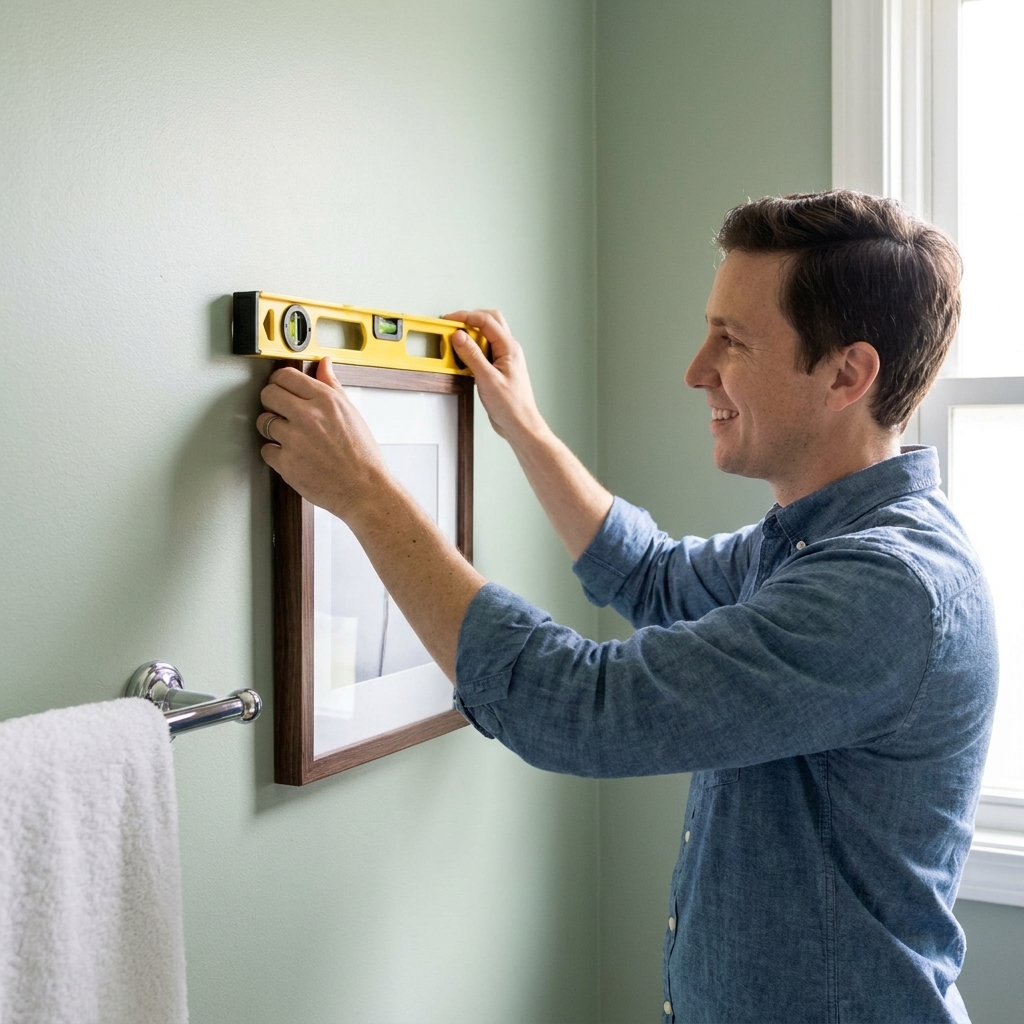
- Use painter’s tape to set level lines for the tops or centers of frames. I swear by The Painter’s Tape Method for Perfectly Level Art when I’m working fast.
- Pick the right hardware based on frame weight and wall type. Start here: Picture Hanging Hardware Explained.
Two laundry-room-specific checks
- Watch door swings. Check swing paths for bifold doors, cabinet doors, and that one hamper that always tips.
- Give heat and steam some space. Avoid placing frames directly over a vent or too close to a frequently used steamer. A few extra inches matter.
Quick placement rule of thumb: If you’re hanging art over a counter or folding surface, I like the bottom edge of the lowest frame to sit roughly 6 to 8 inches above the surface. For a skinny wall strip (like next to a door), aim to center the grouping around eye level when you’re standing in the room.
If your laundry room has concrete or brick walls, you’re not doomed. I have a full walkthrough in How to Hang Art on Brick and Concrete.
Mudroom styling ideas
Mudrooms are basically laundry rooms in public. You want the charm, but it has to survive real traffic.
Try these pairings
- Vertical gallery wall plus hooks: Keep art above the hook line so coats do not scrape it. If kids and pets are part of the chaos, this is another place I’d choose acrylic over glass.
- Small grid plus narrow bench: A tidy grid makes a small landing area feel intentional.
- One ledge plus a few frames: If you like to rotate prints seasonally, a ledge lets you swap without new holes. See Picture Ledge Layouts.

A starter formula
If you’re standing in your laundry room right now wondering where to begin, do this:
- Choose 4 frames: two 8x10s, two 5x7s.
- Choose one theme: botanicals, vintage ads, or black-and-white family photos.
- Hang a 2x2 grid: start with about 1.5 to 2 inches between frames, centered in your chosen wall zone.
- Use mats: even basic off-the-shelf mats make everything look calmer.
That’s it. Four frames is enough to change the mood of the room without turning laundry into a full renovation project.
Common questions
Should I use glass or acrylic?
If the room is tight and things get bumped, acrylic is lighter and less stressful. If you’re framing something valuable and the area is low-traffic, glass can feel more premium. Either way, prioritize UV-filtering glazing if fading is a concern, and use a solid backing and dust cover to help protect the art in a humid space. More detail is in Choosing the Right Picture Frame Glass.
What size art works best above a washer and dryer?
I like a short horizontal band: a tiny triptych (three small frames) or 2 to 4 pieces in a row. Keep the bottoms high enough that detergent bottles and baskets don’t visually fight with the frames.
How do I keep it from looking cluttered?
Repeat one element. It can be frame color, mat color, or a consistent subject like botanicals. If you want to mix finishes, I use the same approach I describe in Mixing Frame Finishes Without the Chaos.
One last nudge
Utility spaces are where your house does the least glamorous work. Adding a small, vertical gallery wall isn’t about making laundry fun, but it can make the room feel like it belongs to you. Start small, hang it sturdily, and let it be a little imperfect. Honestly, that’s the most lived-in kind of beautiful.
If you want more room-specific ideas, you can browse the rest of Room by Room Styling.